Dancify
Practice7 min read
How to keep a dance practice journal: what to track, with prompts
Corrections fade, small wins get forgotten, and three weeks of classes blur into one. A practice journal keeps them. What to write, a five-minute entry, prompts for when the page stays blank, and how to look back.
On this page
Ask a dancer what they worked on three weeks ago and most of us draw a blank. The corrections, the small win in Thursday's class, the section that finally clicked: they all blur together. A practice journal keeps them. It takes five minutes after you dance, and it turns a stack of classes into something you can learn from.
A dance practice journal is a short record you write after every class or practice: the date, what you worked on, one thing that went well, one thing to fix, and a link to the video. Keep each entry to about five minutes, then read back once a week to choose what to focus on next.
- Track: date, class or practice, piece and section, corrections you got, how your body felt, the take you filmed.
- Write: straight after dancing, while the corrections are still in your ears.
- Look back: weekly for patterns, monthly to see how far you've come.
Why keep a dance diary?
Because memory is a poor record of practice. You remember the class where everything went wrong and forget the five quiet ones where your turns got a little cleaner. A journal evens that out.
There's research behind it, too. A large review of 138 studies found that monitoring your progress towards a goal helps you reach it, and that the effect was larger when the progress was physically recorded rather than just kept in mind.1 Writing it down is the part that counts.
Practice research points the same way. The work behind the idea of "deliberate practice" describes improvement as effortful practice aimed at specific weaknesses, with feedback.2 A journal is where those weaknesses get named, and where the feedback from your teacher doesn't evaporate by Saturday.
What to track in a dance practice journal
Start with the first four rows. Add the rest when writing them feels easy.
| What to note | Example | Why it helps |
|---|---|---|
| Date and kind | Tue, jazz class (75 min) | Shows your real rhythm of practice |
| What you worked on | "Slow Burn", counts 3–4 of the chorus | Lets you find any section's history |
| One win | Double pirouette landed three times in a row | Progress you'd otherwise forget |
| One thing to fix | Arms late on the "and" before 5 | Your focus for next time |
| Corrections you got | "Lift out of the hip in the développé" | Teachers repeat themselves; you'll see which ones |
| The video | Full run, take 2 | The evidence behind the words |
| Body and energy | Tired, left ankle stiff after jumps | Spots overload before it becomes injury |
| Milestones | First clean run of the whole piece | The days you'll want to find again |
Tags help later: the piece, the style, the skill ("turns", "floor work", "musicality"). Keep the list short so you actually use it.
The five-minute entry, step by step
- Write it within the hour. On the bus, in the changing room, before you shower. Corrections fade fast.
- Start with the facts. Date, class or practice, how long, which piece. Thirty seconds.
- Name one win. Be specific: not "good class" but "kept my heels down in the chassé". Small wins are the point.
- Name one thing to fix. Only one. A list of ten is a list of none.
- Copy the correction word for word. Your teacher's exact phrase is often the cue that makes it click later.
- Attach a take. Even 30 seconds of the section. Words say what you think happened; video shows what did. If you're not filming yet, our guide to filming yourself dancing covers the setup.
- Write tomorrow's first task. "Start with the arm timing in the chorus." Then you walk into the next practice with a plan.
A real entry, start to finish. "Thu 24 Oct, own practice, 40 min, Slow Burn. Win: the turn sequence in the second chorus is finally on the music. Fix: I travel too far on the slide on 6 and arrive late for 7. Teacher's note from Tuesday: 'Smaller, faster, then bigger.' Take: full run, take 3. Body: fine, calves tight. Tomorrow: slide on 6 with a mark on the floor, ten loops."
That's under a hundred words and two minutes of typing. If you practise at home between classes, pair the journal with a simple weekly practice plan, so each entry has something to report back on.
Journaling prompts for dancers
When the page stays blank, pick one prompt and answer it in two sentences.
- After classWhich correction did I hear twice? What did the teacher demonstrate that I want to steal? What felt different today?
- After your own practiceWhat did the video show that I didn't feel? Which eight-count still needs counting in my head?
- After a performanceWhich moment felt most alive? What did nerves change? What would I keep exactly the same?
- When you feel stuckWhat could I do a month ago that I can do now? (Then go and watch that month-old take.)
- Body checkWhere am I tight, sore or tired? Is it the same place as last week?
Look back: the weekly and monthly review
A diary nobody reads is just storage. Ten minutes once a week is where the patterns show up.
- Read the weekAll the entries, in order. Which "thing to fix" keeps coming back?
- Watch two takesThe first and last take of the same section this week. Is the fix showing?
- Choose one focusOne skill or section for next week. Write it at the top of the next entry.
Read yesterday's entry before today's practice, too. Sleep seems to help motor skills settle: in a well-known study, people who learned a finger-tapping sequence were about 20% faster after a night's sleep, while the same hours awake brought no significant gain.3 Dance is far more complex than finger-tapping, but the habit costs nothing: start where yesterday ended, not from scratch.
Once a month, go further back. Put your first take of a piece next to the latest one. That's often the moment you see how much has changed, and it's the raw material for a dance progress video.
Paper notebook or app?
A paper notebook
- Great for
- Writing by hand, sketching floor patterns and formations, no screen after class.
- Harder at
- Connecting a note to the video it's about. Searching for "every time I worked on fouettés".
A dance diary app
- Great for
- Keeping the note, the take and the date together, finding a piece's history in seconds, seeing a month at a glance.
- Harder at
- Drawings and diagrams. Some dancers keep both: the app for takes, a notebook for formations.
A journal, not a scoreboard. Skip streaks and daily quotas; rest days belong in the diary too. If you keep noting the same pain, show your notes to your teacher or a physiotherapist. That's one of the most useful things a journal can do.
How Dancify keeps the diary for you
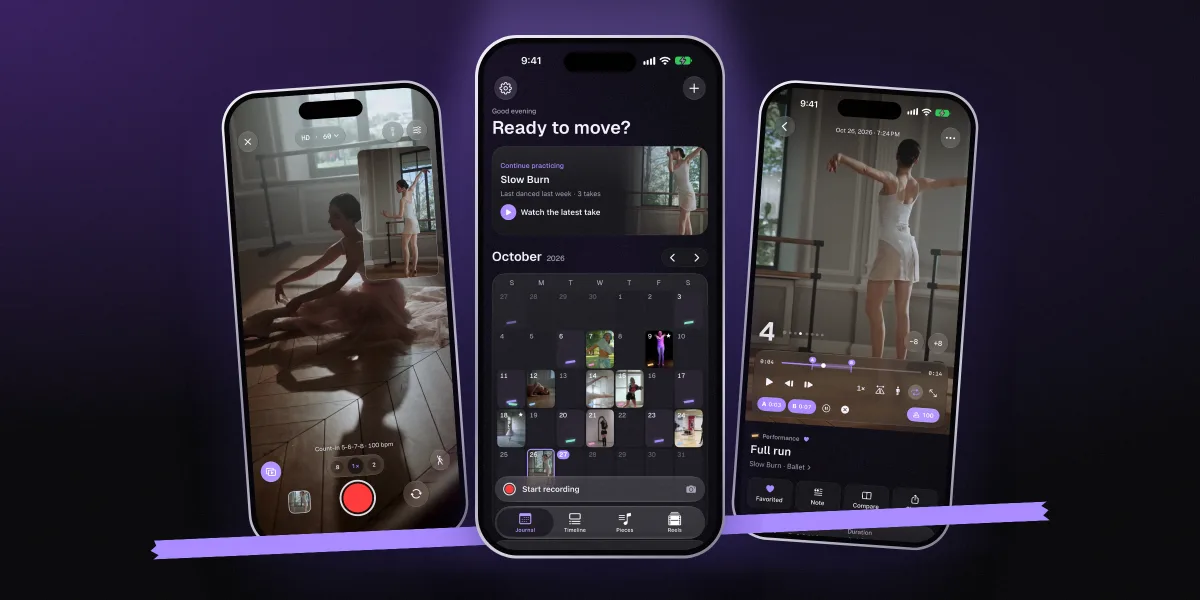
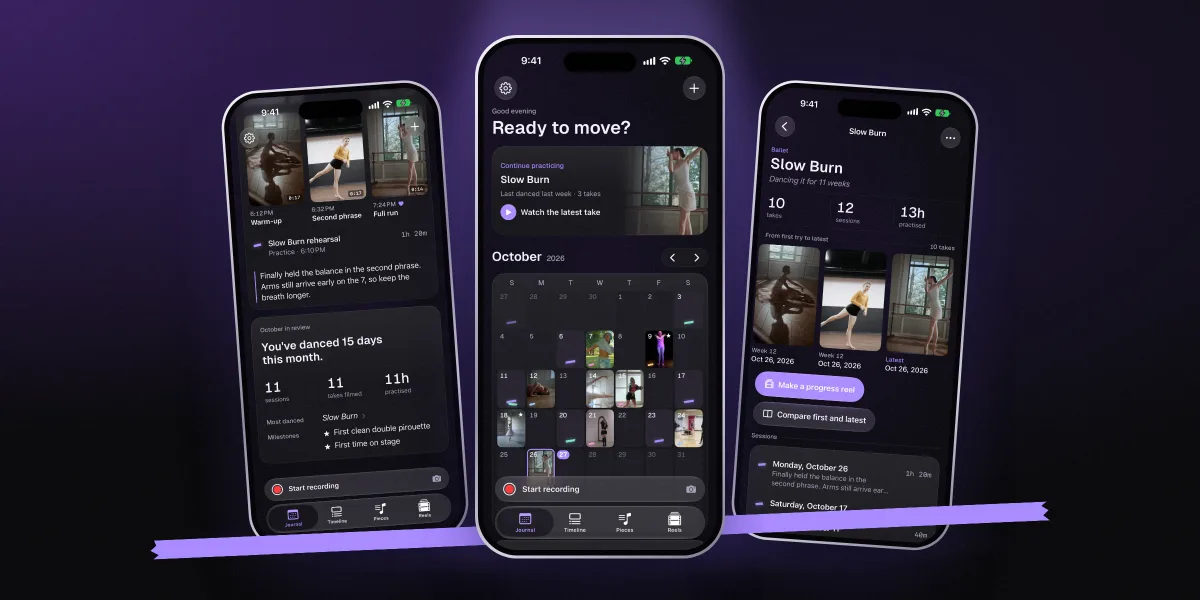
Dancify is built around the idea that a dance diary should be made of your own footage. Film a take and a frame from it lands on that day in your calendar; over weeks, the month fills with your own dancing.
-
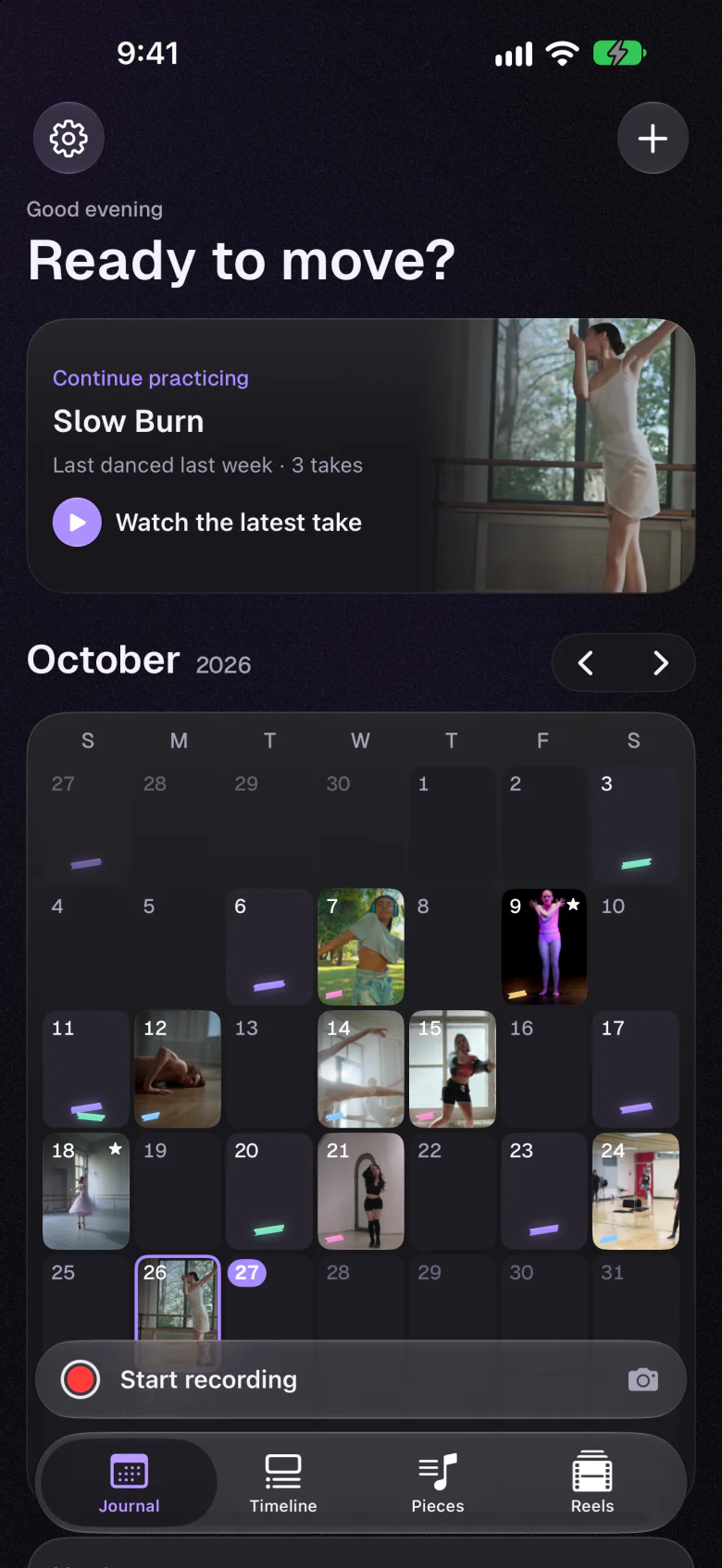
A calendar of framesEach day shows a frame from what you danced; several takes stack like prints. Free.
-
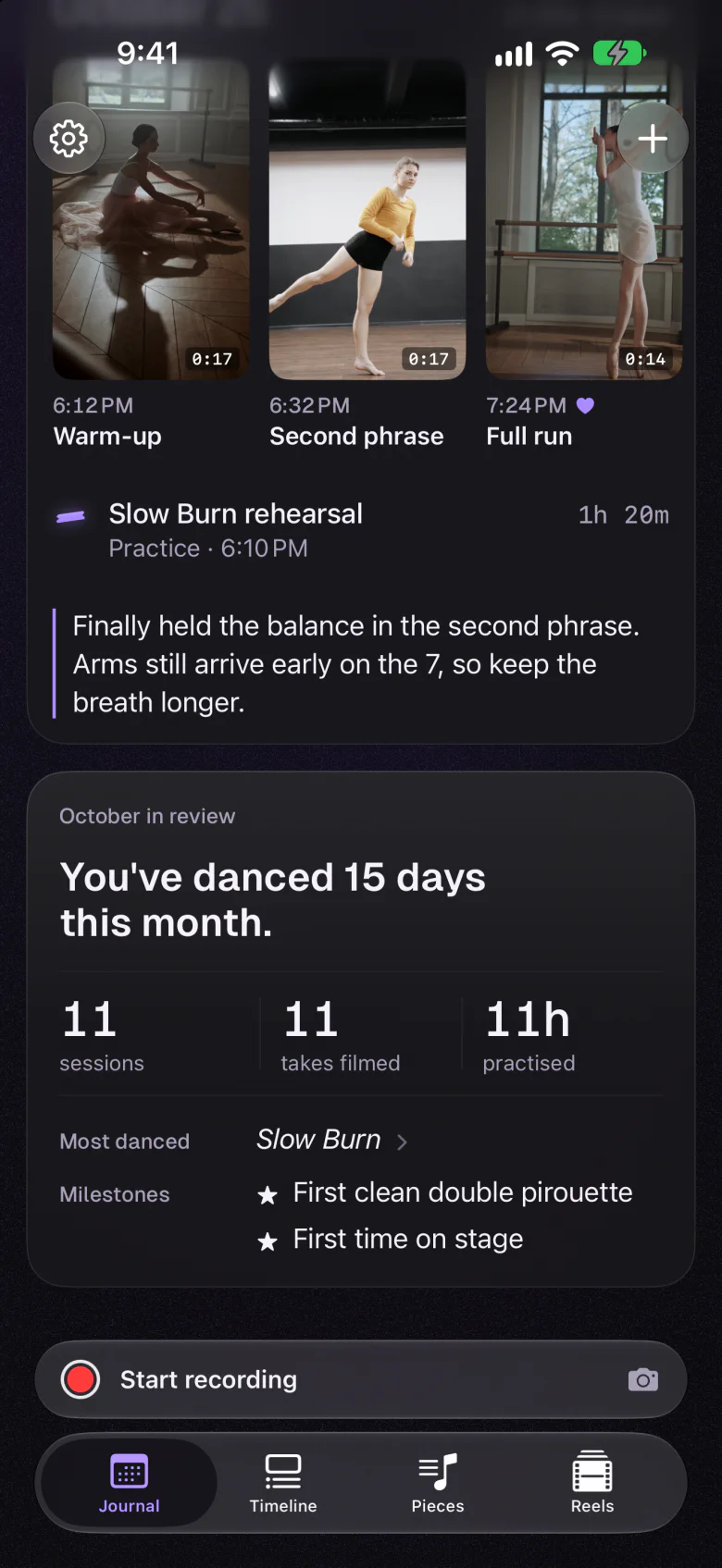
The day, with notesTakes, notes, tags, favourites and milestones together. Classes can be logged without video.
Pieces keep every take of a choreography in order, the timeline filters by kind of practice, and a month review shows what you danced most. "Log practice" also works from Siri and Shortcuts. The diary is free, there's no account, and it stays on your device or in your own iCloud.
Five minutes after practice is enough
Film a take or log a class, add one line, and watch the month fill with your own dancing.
- Calendar of frames from your takes
- Notes, tags, favourites, milestones
- Every take of a piece, in order
Questions, answered
What should I write in a dance journal?
The date and kind of practice, what you worked on (piece and section), one thing that went well, one thing to fix, any corrections in your teacher's own words, how your body felt, and a link to the take you filmed. Five minutes is enough.
How do I track my dance progress?
Combine short notes with video. Film the same section from the same angle regularly, write one line about what changed, and once a month put your first take next to your latest. The notes tell you what to look for; the video shows whether it happened.
How often should I write in my dance diary?
After every class or practice, ideally within an hour, and keep it short. Then read back once a week for ten minutes and choose one focus for the next week. Rest days can go in too; there's no need for a daily streak.
Is a paper dance journal or an app better?
Paper is great for handwriting and drawing formations. An app is better at keeping the note, the video and the date together and at finding a piece's history quickly. Many dancers use both.
Does keeping a practice journal actually help?
Research on goal monitoring says yes: a review of 138 studies found that tracking progress helps people reach their goals, more so when progress is physically recorded. For dancers, the journal also keeps corrections from being forgotten and makes progress visible on slow weeks.
Sources
- Harkin B, Webb TL, Chang BPI, et al. (2016). Does monitoring goal progress promote goal attainment? A meta-analysis of the experimental evidence. Psychological Bulletin 142(2), 198–229. Checked 2026-11-04. eprints.whiterose.ac.uk
- Ericsson KA, Krampe RT, Tesch-Römer C (1993). The role of deliberate practice in the acquisition of expert performance. Psychological Review 100(3), 363–406. Checked 2026-11-04. doi.org
- Walker MP, Brakefield T, Morgan A, Hobson JA, Stickgold R (2002). Practice with sleep makes perfect: sleep-dependent motor skill learning. Neuron 35(1), 205–211. Checked 2026-11-04. pubmed.ncbi.nlm.nih.gov