Dancify
Practice9 min read
How to practise dance at home: space, warm-up and a weekly plan
A living room has no teacher, no sprung floor and no plan. Here's how to set up a safe space, warm up, structure a 30-minute session and build a week that improves you without wearing you out.
On this page
Class gives you the steps. Home is where they become yours. The trouble is that a living room has no teacher, no sprung floor and no plan, so practice either turns into scrolling for a tutorial or into the same run-through ten times. A little structure fixes most of that.
To practise dance at home, do three to five short sessions a week of 20 to 45 minutes, each with a 10 to 15 minute warm-up, one clear focus, a few targeted drills, a run of your choreography and one recorded take. Clear a safe space, match your footwear to the floor, keep jumps low on hard floors and take at least one or two full rest days a week.
- Floor: wood is kindest; on tile or concrete, cut the jumps. Socks or soft shoes on carpet, bare feet or grippy soles on smooth floors.
- Session: warm up, drill, run, film, cool down.
- Week: mix technique, choreography and conditioning, and leave room to recover.
Set up a safe space
You need less room than you think: about two by two metres for most technique, more for travelling steps and turns. What matters more is what's around and under you.
Before you start, walk the space. Move anything you could hit or trip on, tape down loose cables, and put fragile things somewhere else. The Imperial Society of Teachers of Dancing (ISTD) recommends exactly this for home dancing, and adds a good habit: walk through your choreography slowly once to find the obstacles before you dance it full out.1 Check the ceiling too, if your piece has jumps or arm lines overhead.
Floors, shoes and socks
Studios use sprung floors because they give a little under a landing, which takes some load off ankles, knees and shins. Most home floors don't give at all, so the rule is simple: the harder the floor, the fewer and lower the jumps.
| Floor | What it's like | Wear | Go easy on |
|---|---|---|---|
| Wood or laminate on joists | The best home option: a little give, smooth | Bare feet, dance shoes, socks if you need to turn | Long jump sequences |
| Tile, stone or concrete | Hard, no give, can be slippery | Trainers or dance sneakers with grip | Jumps and kneeling floor work |
| Carpet | Grips the foot, can burn skin | Socks or soft dance shoes | Turns, sliding, knee work without cover |
| Roll-out dance mat or practice board | Studio-like surface on top of your floor | Whatever the style needs (taps on a tap board) | The edges, where you can catch a foot |
The ISTD's footwear advice matches this: grippy soles outdoors and on slippery surfaces, socks or soft dance shoes on carpet, bare feet or grippy dance shoes on smooth indoor floors, and covered skin on carpet or rough surfaces to avoid burns.1 If a floor is wet or slick, dry it or put down a mat that grips.
Warm up properly, even for 20 minutes
At home it's tempting to skip the warm-up because there's no teacher starting the barre. Don't. A warm-up should raise your heart rate, mobilise your joints and gently stretch the muscles, gradually, so you don't overdo it before you've started.1
- Raise the heart rate (3–4 minutes). March or jog on the spot, bounce, step-touch to a song you like.
- Mobilise (3–4 minutes). Circles and rolls through the ankles, knees, hips, spine, shoulders and neck.
- Move dynamically (4–5 minutes). Leg swings, pliés, lunges with a twist, small grooves in your style.
- Rehearse the patterns (2 minutes). The movements you're about to drill, small and easy, then bigger.
Keep long held stretches mostly for after practice. In a small study with trained dancers, dynamic stretching or a combination of static and dynamic stretching gave better jump height than static stretching alone, and the combination also gave better balance.2 Ten dancers is a small study, but it matches what most teachers do: move first, hold later.
Plan each session
A good home session has one focus. "Clean the turn sequence in the second chorus" is a focus. "Practise" isn't. Here's a 30-minute shape you can stretch to 45:
| Minutes | Block | What you do |
|---|---|---|
| 0–10 | Warm-up | Heart rate, joints, dynamic movement |
| 10–18 | Drills | Two or three drills for today's focus, slow then at tempo |
| 18–25 | Choreography | The section you're working on, in small chunks, then joined up |
| 25–27 | One take | Film the section once, full out, from your usual spot |
| 27–30 | Cool-down and note | Easy stretches, then one sentence about what you noticed |
A weekly plan for beginners and intermediate dancers
These plans assume you also have one or two classes a week. Count a class as a session, and move days around to fit your life. What matters is the mix and the rest.
| Day | Beginner (3 sessions) | Intermediate (4–5 sessions) |
|---|---|---|
| Mon | Technique, 25 min: basics and posture | Technique, 40 min: turns or jumps focus |
| Tue | Class | Class |
| Wed | Rest or a walk | Choreography, 35 min + one take |
| Thu | Choreography, 25 min + one take | Conditioning, 20 min + mobility |
| Fri | Rest | Rest |
| Sat | Class or freestyle, 30 min | Class, or a full run + one take |
| Sun | Rest; watch the week's takes | Freestyle or light technique, 25 min; watch the week's takes |
Add time before you add days. Going from three to five sessions in one week is how overuse injuries start.
Drills that work in a living room
- Ballet and contemporaryA chair or kitchen counter as a barre: pliés, tendus, relevés and balances. Short, slow and precise beats long and sloppy.
- Hip-hop, heels and commercialGrooves and bounces to a metronome or a single song for three minutes without stopping. Then isolations: head, chest, hips.
- TurnsPrep and spot drills, then quarter and half turns before full ones. Socks on wood if your floor grips too much.
- Choreography and coversLoop one eight-count until it's clean at half speed, then at tempo, then join it to the next one.
- Partner stylesBasics and timing alone: salsa or bachata basic on the beat, frame and arm styling, footwork patterns.
- Tap and IrishRudiments on a practice board at a slow, steady tempo, then faster in small steps.
For choreography, the way you break a piece into chunks matters as much as the time you spend. Our guide to learning choreography faster goes deeper, and counting music helps if you lose your place in the song.
Ten minutes of conditioning
Most dance injuries are in the lower body. In a systematic review of ballet injuries, the lower body (hips, legs, ankles and feet) accounted for 66 to 91 percent of all injuries across the studies.3 Strong feet, ankles and hips are your best protection, and they need no equipment:
- Calf raises: slow, on both feet then one foot, 2 × 12.
- Single-leg balance: 30 seconds each side, then with eyes closed.
- Glute bridges: 2 × 12, then single-leg.
- Side plank: 20 to 30 seconds each side.
- Foot doming or towel scrunches: one minute each foot.
Record one take per session
The mirror shows you one angle while you're busy dancing. A recording shows you what actually happened. You don't need to film everything; one take of today's focus, from the same spot every time, is enough. Write one sentence next to it: what improved and what to fix next time.
After a few weeks those takes become something better than motivation: evidence. Keep them in a practice journal, and when you have a month or two, put the first and the latest side by side as a progress video. If you're unsure about the setup, see how to film yourself dancing.
Rest and injury prevention
Home practice comes on top of class, so it's easy to do too much. Most dance injuries come from overuse rather than accidents: in the same review, 75 percent of injuries among amateur ballet dancers were overuse injuries.3 That's the kind of injury that builds quietly from too many repetitions with too little recovery.
- Take one or two full rest days a week. Light walking and gentle mobility are fine.
- Vary the load. Don't put jumps or deep floor work on consecutive days.
- Sleep counts as practice. In a well-known sleep study, people got about 20 percent faster at a newly learned finger-tapping sequence after a night's sleep, with no such gain after the same time awake. Fingers aren't feet, but the idea that skills settle overnight is a good reason not to cut sleep for extra rehearsal.4
- Drink water during practice, not just after.
Stop and get it checked if pain is sharp, if it changes how you move, if there's swelling, or if the same spot still hurts the next morning. A physiotherapist or doctor who works with dancers can tell you what's going on and how to keep dancing safely. This guide is general information, not medical advice.
Where Dancify fits
Home practice goes better with a few tools a living room doesn't have. Dancify puts them in one app for iPhone and iPad.
-
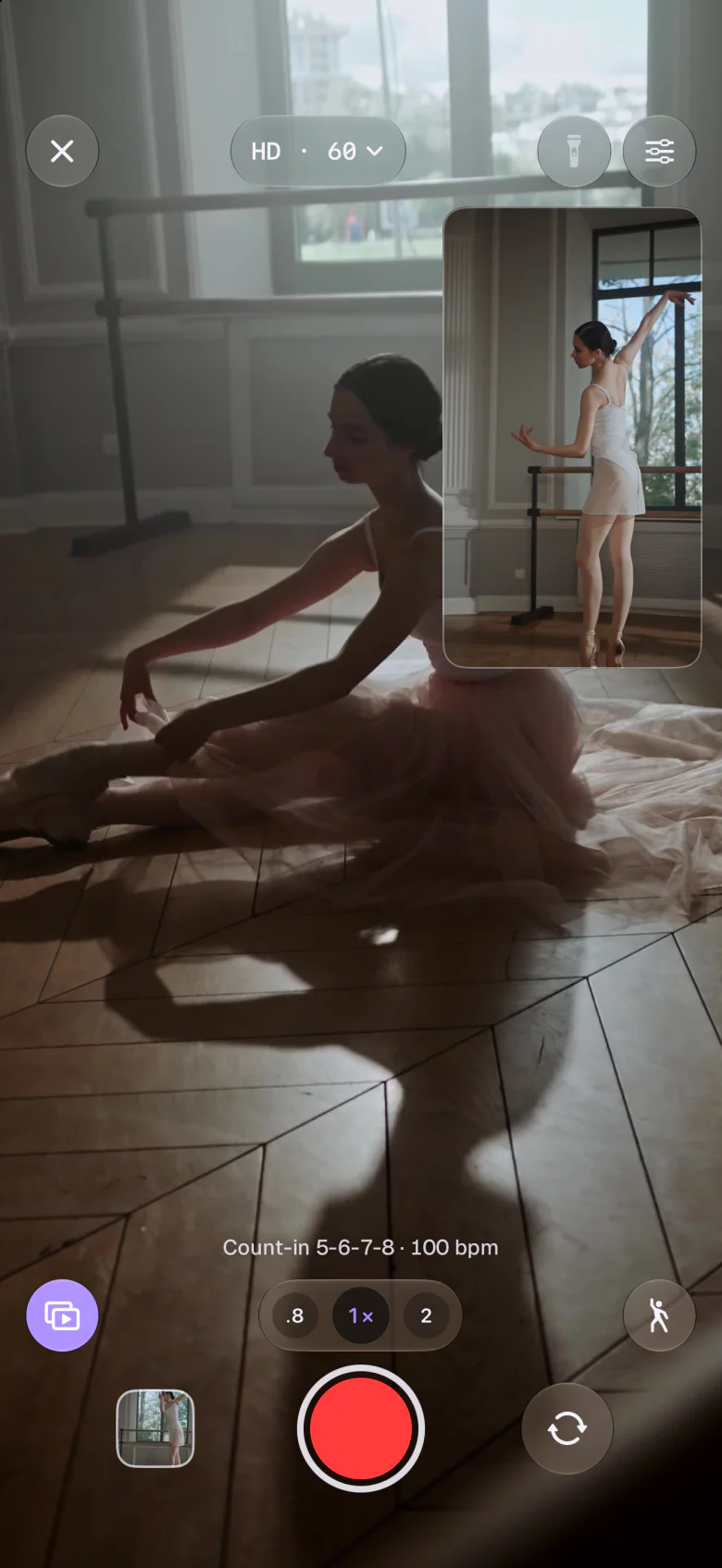
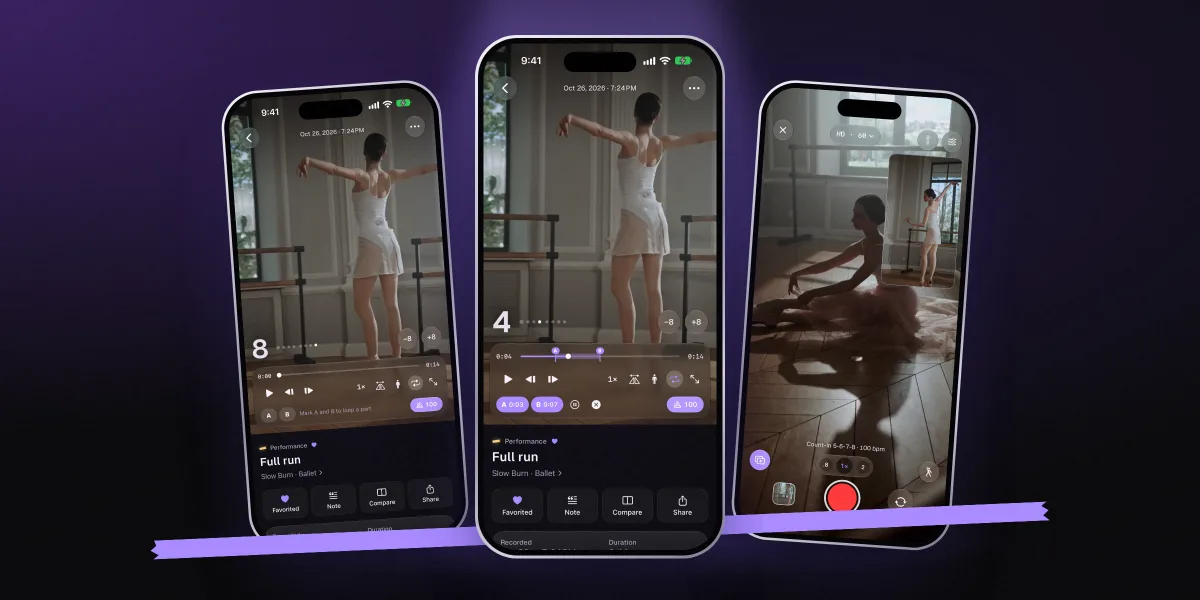
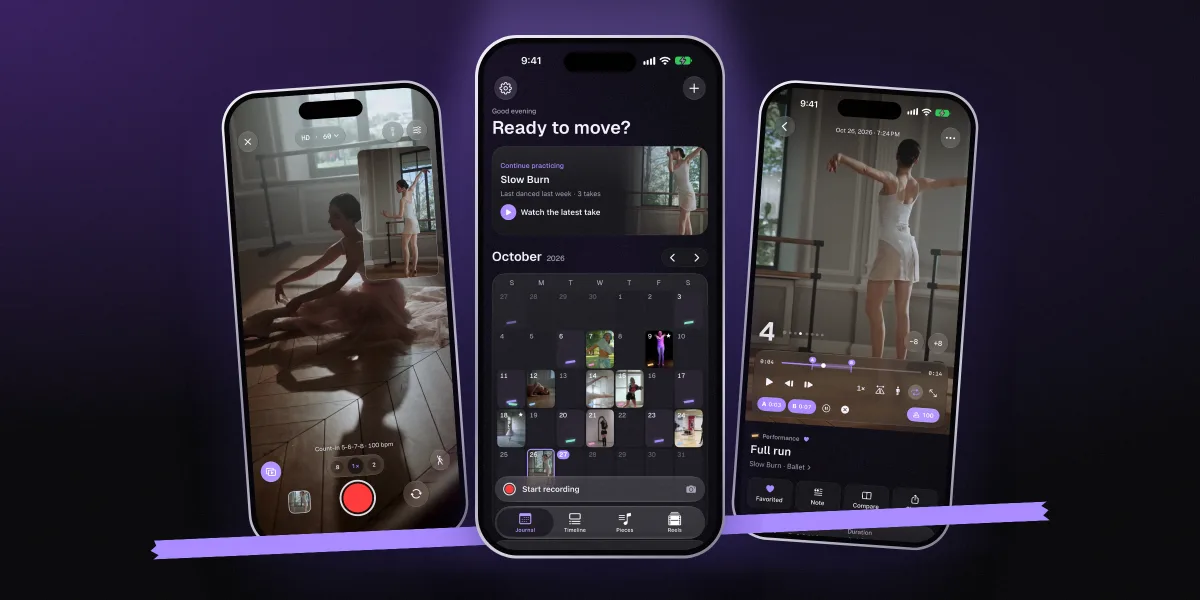
Practise with a referencePlay your teacher's video or your own earlier take while you film, starting on the count-in's downbeat.
-
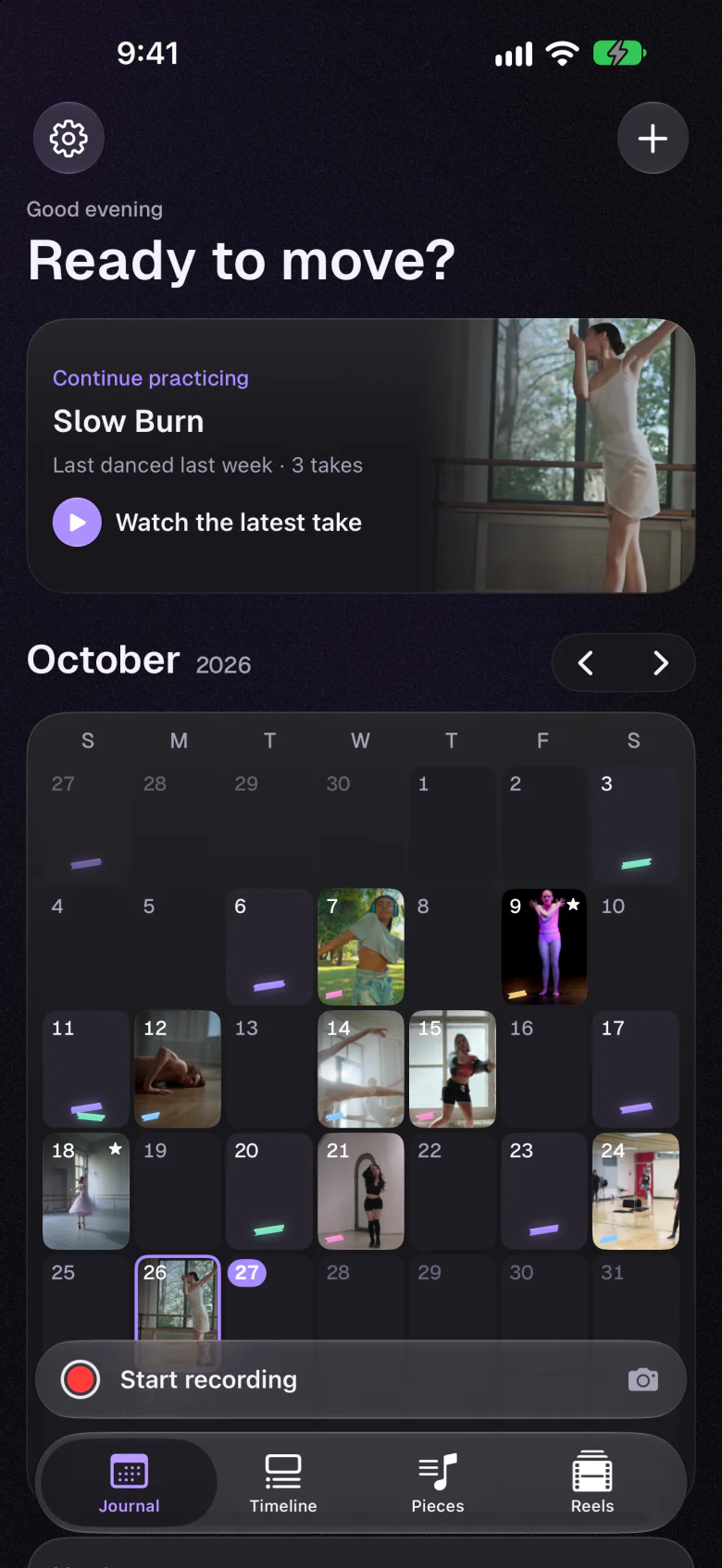
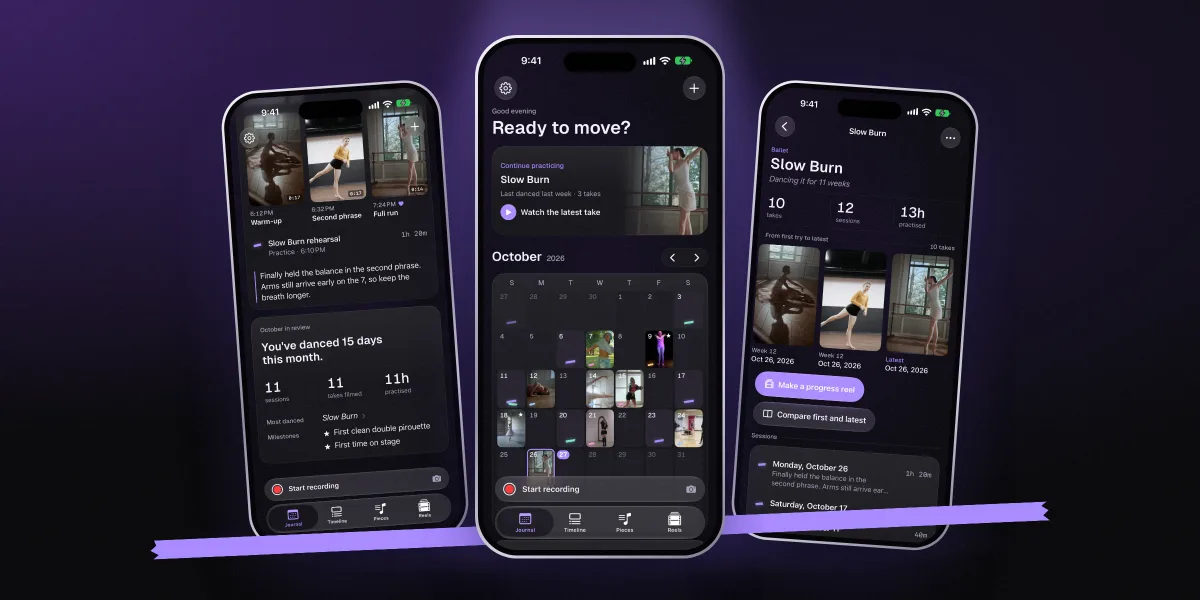
A calendar of framesEach day shows a frame from what you danced, and days without video still get logged.
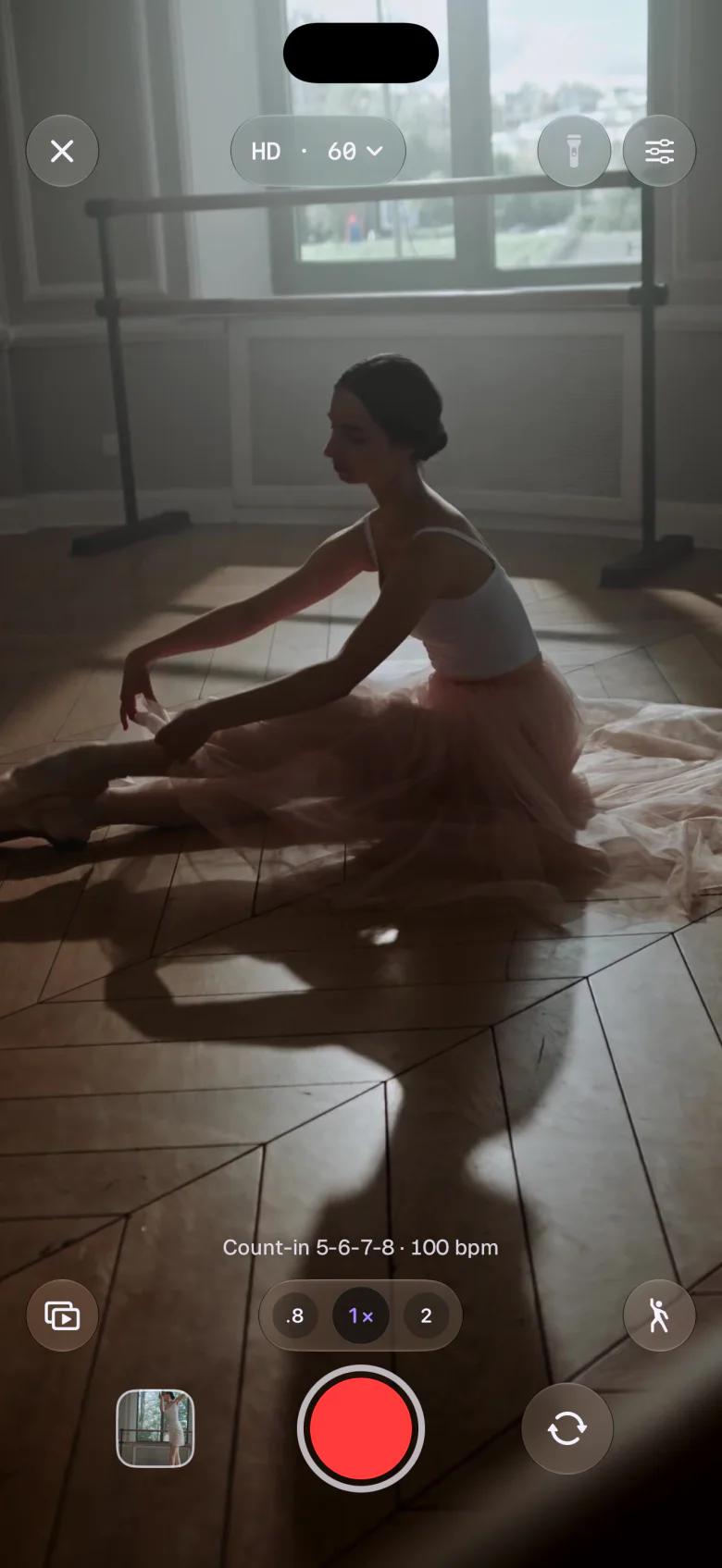
A musical count-in ("5, 6, 7, 8") gives you time to walk to your mark before the take starts. Recording, the calendar, notes and the editor are free, with no account and no ads; videos stay on your device or in your own iCloud.
Three sessions, three takes
Warm up, pick one focus, film one take. Next Sunday you'll have three clips that tell you more than a month of guessing.
- Count-in and reference video while filming
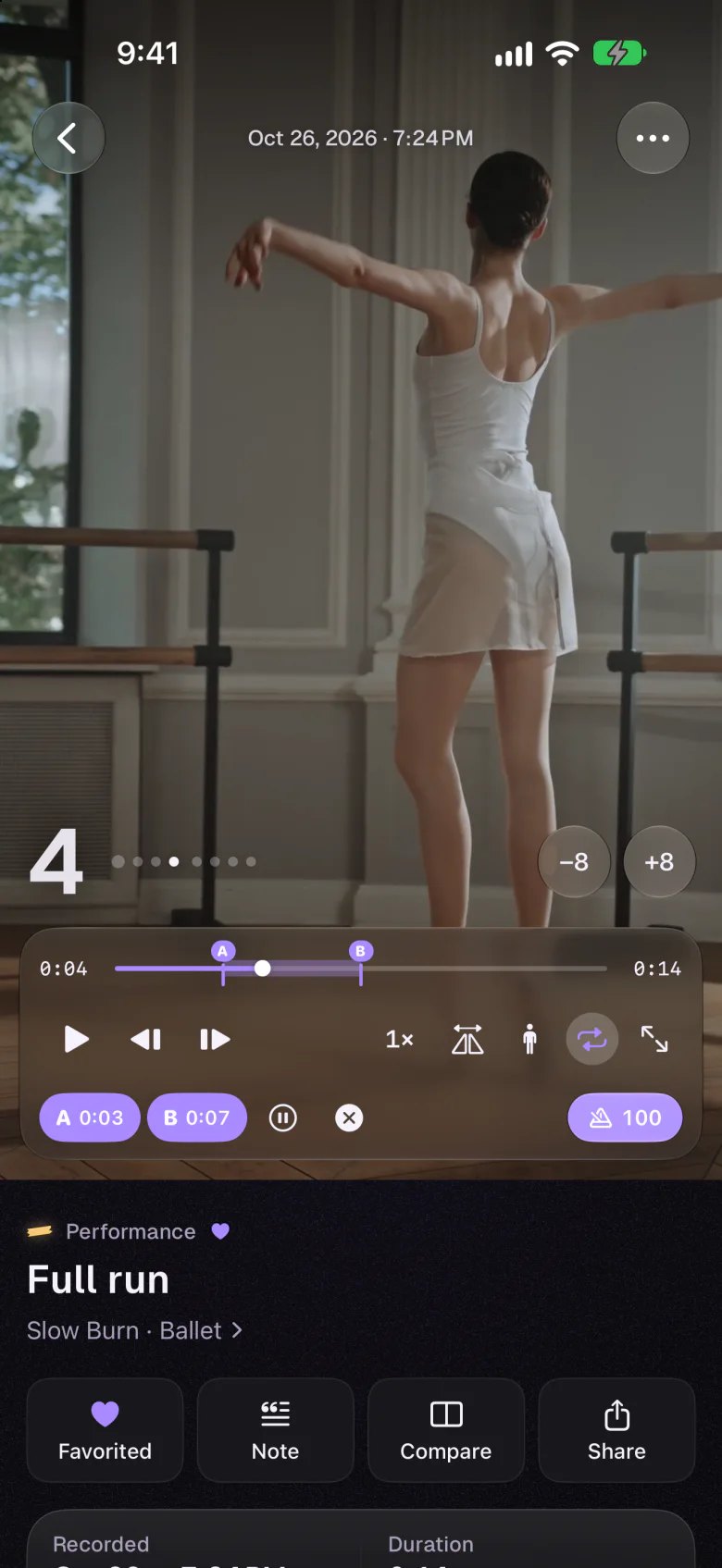
- A–B loop, slow motion, mirror and counts
- Every take on its day in the calendar
Questions, answered
How often should I practise dance at home?
Three to five sessions a week of 20 to 45 minutes works for most beginners and intermediate dancers, counting classes as sessions. Beginners can start with three; add time to each session before you add more days, and keep one or two full rest days a week.
Can I dance on a hard floor at home?
Yes, but adapt. Tile, stone and concrete have no give, so keep jumps few and low, wear trainers or dance sneakers with grip, and avoid kneeling floor work without padding. Wood or laminate is the kindest home floor, and a roll-out dance mat or practice board gives you a studio-like surface on top.
Should I dance in socks or barefoot at home?
It depends on the floor. The ISTD suggests socks or soft dance shoes on carpet, bare feet or dance shoes with a grippy sole on smooth indoor floors, and shoes with grip on slippery surfaces. On carpet or rough floors, cover your skin to avoid burns.
How long should a dance warm-up be?
About 10 to 15 minutes. Raise your heart rate, mobilise your joints, move dynamically through your style's patterns and gently stretch, gradually. Keep long held stretches mostly for after practice.
What should a beginner practise at home?
Basics and posture for your style, short drills at a slow tempo, one small section of choreography until it's clean, and ten minutes of conditioning for feet, ankles and hips. Film one take per session so you can see what's actually changing.
How do I avoid injury when practising dance at home?
Warm up every time, clear the space, match footwear to the floor, limit jumps on hard floors, increase your practice gradually and take rest days. Most dance injuries are overuse injuries, so recovery matters. See a physiotherapist or doctor if pain is sharp, causes swelling or changes how you move.
Sources
- Imperial Society of Teachers of Dancing (2021). ISTD Challenge: your health and safety (warm-up, obstructions, floor surfaces, footwear). Checked 2026-11-04. istd.org
- Morrin N, Redding E (2013). Acute effects of warm-up stretch protocols on balance, vertical jump height, and range of motion in dancers. Journal of Dance Medicine & Science 17(1), 34–40. Checked 2026-11-04. pubmed.ncbi.nlm.nih.gov
- Smith PJ et al. (2015). Incidence and prevalence of musculoskeletal injury in ballet: a systematic review. Orthopaedic Journal of Sports Medicine 3(7). Checked 2026-11-04. pubmed.ncbi.nlm.nih.gov
- Walker MP et al. (2002). Practice with sleep makes perfect: sleep-dependent motor skill learning. Neuron 35(1), 205–211. Checked 2026-11-04. pubmed.ncbi.nlm.nih.gov