Dancify
Musicality7 min read
How to count music in dance: eight-counts and finding the one
Why do teachers start at five? Where is one? What's an "and"? Beats, bars, eight-counts and phrases explained, plus waltz, salsa and swing counts, tempo by style and five drills.
On this page
"Five, six, seven, eight!" is the first thing most of us hear in a dance class, and for a lot of beginners it's also the most confusing. Why start at five? Where is "one"? And what is an "and"? Counting music is a skill like a pirouette: a few rules, then lots of practice. Here are the rules.
Most dance music is in 4/4 time: four beats to a bar. Dancers count two bars together as one eight-count, 1 to 8, and four eight-counts usually make a musical phrase. "5, 6, 7, 8" is the lead-in: the last four counts before the dance starts on the next 1. An "and" is the half-beat between two counts, and waltzes are in 3/4, counted 1-2-3.
- Beat: the steady pulse you tap your foot to. Each beat is one count.
- Eight-count: eight beats, two bars of 4/4. The unit choreography is built in.
- Phrase: usually four eight-counts (32 beats). New sections of a song tend to start at the top of a phrase.
Beats, bars and eight-counts
Musicians organise music into bars (measures). The time signature says how many beats are in each bar: 4/4 means four beats per bar, 3/4 means three.1 Almost all pop, hip-hop, jazz, K-pop, house and Latin music is in 4/4.
Musicians count each bar "1, 2, 3, 4". Dancers count two bars together, "1, 2, 3, 4, 5, 6, 7, 8", because most dance steps and combinations take longer than one bar to finish. One eight-count is one sentence of movement; four of them make a paragraph, the phrase.
| Term | In 4/4 music | How dancers say it |
|---|---|---|
| Beat | One pulse | One count: "1" |
| Half-beat | Between two beats | "and": "1 and 2 and" |
| Bar | 4 beats | Half an eight-count |
| Eight-count | 2 bars, 8 beats | "1 to 8", "one eight" |
| Phrase | Usually 8 bars, 32 beats | "Four eights" |
What "5, 6, 7, 8" means
When a teacher calls "5, 6, 7, 8", they're counting the second half of an eight-count out loud, in the tempo of the music, so everyone starts together on the next 1. It does three jobs at once: it tells you the tempo, it tells you exactly when "1" will land, and it gives you four counts to get ready. Teachers count only the last four because counting all eight would waste time; the first four are usually silent or just "and".
The first step of the choreography falls on 1, not on 8. Unless the teacher says "and" before 1, which means the movement starts on the half-beat before: a pick-up.
How to find the beat and the one
- Find the pulse. Listen for the kick drum or the bass. Tap your foot or nod your head along. Don't count yet.
- Find the backbeat. In most pop and hip-hop, the snare or clap hits on 2 and 4. The beats between, where the kick usually sits, are 1 and 3.
- Count to four. Say "1, 2, 3, 4" with the beats, with the snare on 2 and 4. When it feels right, it will feel like the music is leaning on your "1".
- Join two bars into eight. Keep going "5, 6, 7, 8". If 1 doesn't feel like a fresh start, shift by four counts.
- Find the big one. Listen for where something changes: the vocals come in, a cymbal crash, the chorus starts, a drum fill ends. That moment is almost always 1 of a phrase. Count four eights from there and you'll usually land on the next change.
Watch out for half phrases. Songs don't always keep neat 32-count phrases. A bridge might add an extra four counts, or an intro might be one bar short. If your counting drifts out of line with the music, start again from the next obvious change. Choreographers count these places specially, so ask.
"And" counts and syncopation
Between every two counts there's an "and": "1 and 2 and 3 and". Fast footwork splits it further: "1 e and a", four sounds per beat. Any move that lands on an "and" instead of a number is off the beat, or syncopated.
- Ball change on "and-1": the quick weight change before a step.
- "Hit on the and of 4": a sharp accent just before the next bar, very common in hip-hop and commercial choreography.
- Holds: syncopation also means not moving on a count you'd expect, then catching up. "Hold 5, 6, hit 6-and" is all about the silence.
When an eight-count feels slippery, slow the music down and say every "and" out loud. Once the timing is in your mouth, it gets into your feet.
Waltz, salsa, swing: when it's not just 1 to 8
- Waltz and 3/4Three beats per bar: "1, 2, 3, 2, 2, 3". The 1 is strong, so it carries the step down. Ballet teachers often count waltzes in sixes, two bars at a time, or "and-a-1" for the pick-up.
- SalsaCounted in eights but stepped on six: "1, 2, 3, (4), 5, 6, 7, (8)". Dancing "on1" breaks forward on 1; "on2" breaks on 2.
- Bachata"1, 2, 3, tap, 5, 6, 7, tap". The tap or hip accent on 4 and 8 marks the bar.
- Cha-cha"2, 3, 4-and-1": the chassé lives on 4-and-1, which is why the dance feels like it starts on two.
- Swing and jiveMany basics are six counts long over 4/4 music, so the pattern drifts across the eight-count. Count the pattern and the music separately until it clicks.
Tempo and BPM by dance style
Tempo is measured in beats per minute (BPM). Ballroom competitions fix tempo ranges in bars per minute, so they convert neatly; most other styles vary from song to song, so treat those numbers as a guide.
| Style | Time | Typical tempo | Source |
|---|---|---|---|
| Waltz | 3/4 | 84–90 BPM (28–30 bars/min) | WDSF2 |
| Viennese waltz | 3/4 | 174–180 BPM (58–60 bars/min) | WDSF2 |
| Tango | 4/4 | 124–132 BPM (31–33 bars/min) | WDSF2 |
| Quickstep | 4/4 | 200–208 BPM (50–52 bars/min) | WDSF2 |
| Rumba | 4/4 | 100–108 BPM (25–27 bars/min) | WDSF2 |
| Cha-cha | 4/4 | 120–128 BPM (30–32 bars/min) | WDSF2 |
| Jive | 4/4 | 168–176 BPM (42–44 bars/min) | WDSF2 |
| Salsa | 4/4 | About 160–220 BPM | SalsaVida3 |
| Bachata | 4/4 | About 108–152 BPM | SalsaVida3 |
| Hip-hop | 4/4 | About 60–100 BPM | Ableton4 |
Ballet class music, contemporary, jazz and K-pop vary too widely for one range. Tap along to find the tempo of the actual track.
Why it matters for practice: learning a combination at 80% of the real tempo is one of the easiest ways to get clean, and knowing the target BPM tells you how far you have to go.
Five drills to get better at counting
- Count the radio. Any song, anywhere: find the 1, count eights out loud through a verse and chorus. Check that the chorus lands on a 1.
- Clap only the 1. Count silently and clap on every 1. Then only on 1 of each phrase. It trains your sense of the big structure.
- Say the "ands". Speak a combination's counts with every "and" while you mark it.
- Slow and build. Practise a hard eight at a slower tempo, then raise it a few BPM at a time.
- Film and check. Record a run with the music audible and watch whether your accents land on the counts. More in how to film yourself dancing.
Counting is also the backbone of learning choreography: once you can hear the eights, breaking a piece into chunks becomes natural. See how to learn choreography faster.
How Dancify helps you count
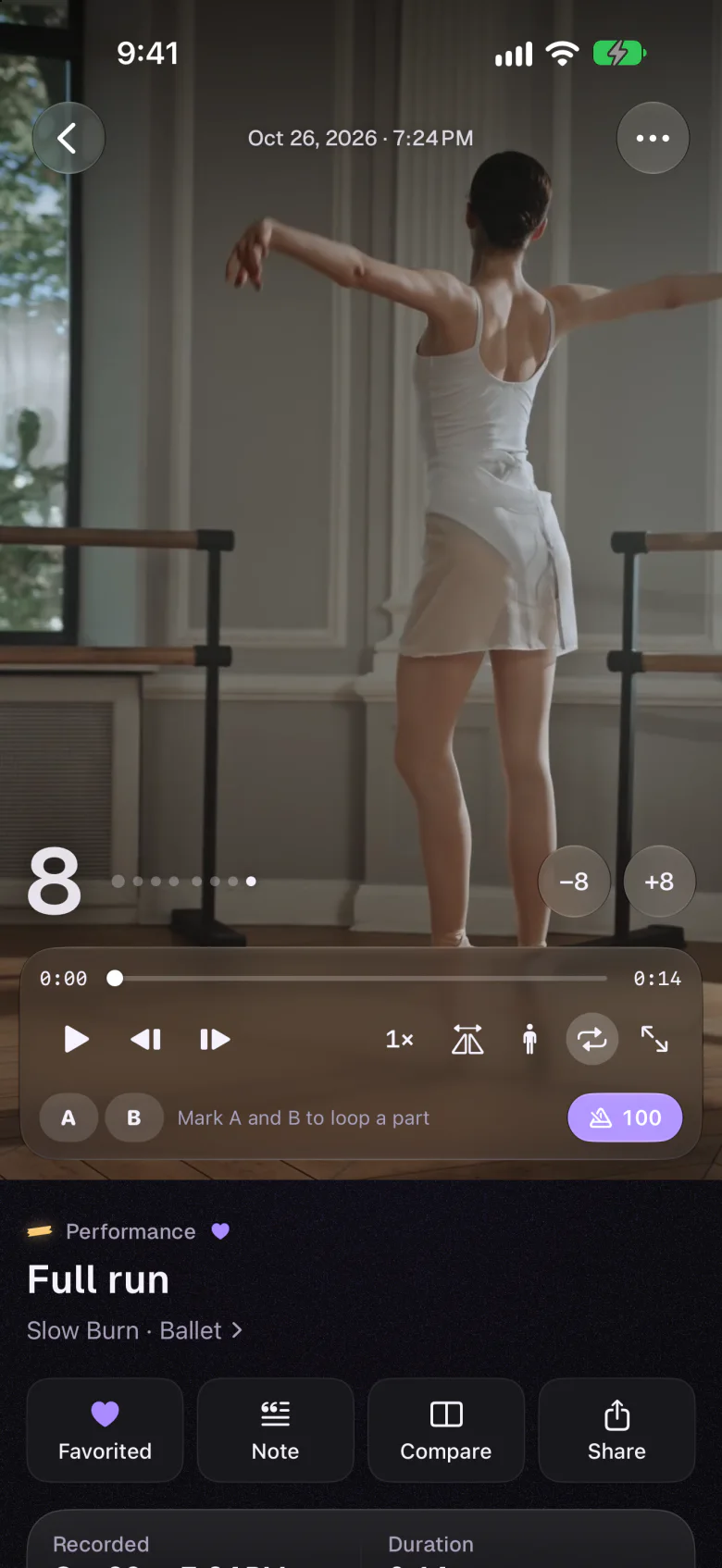
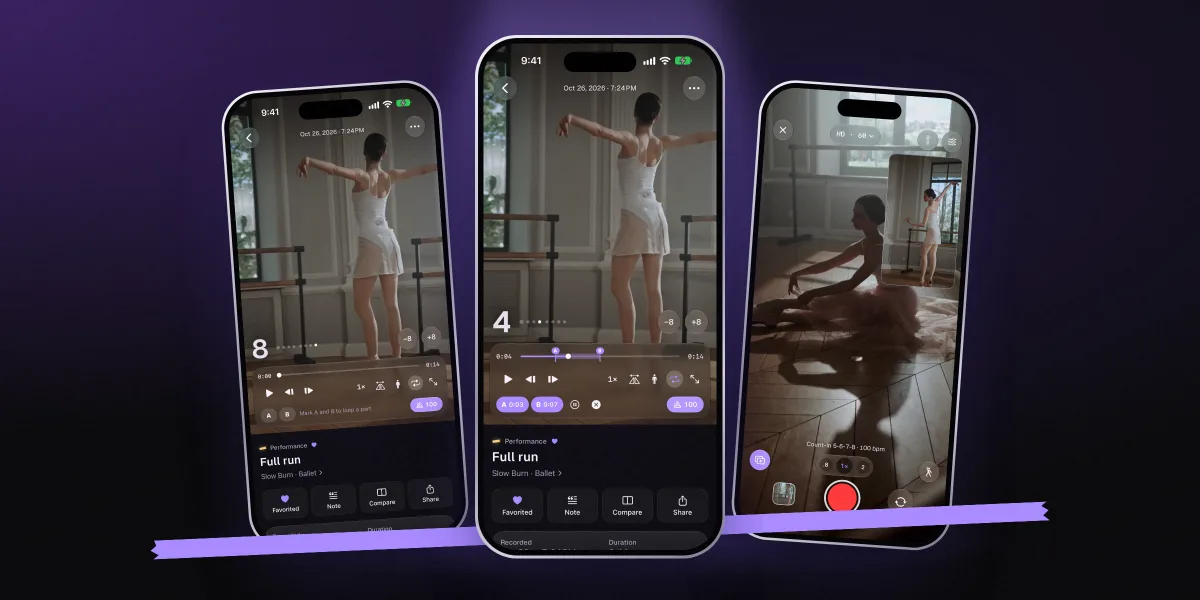
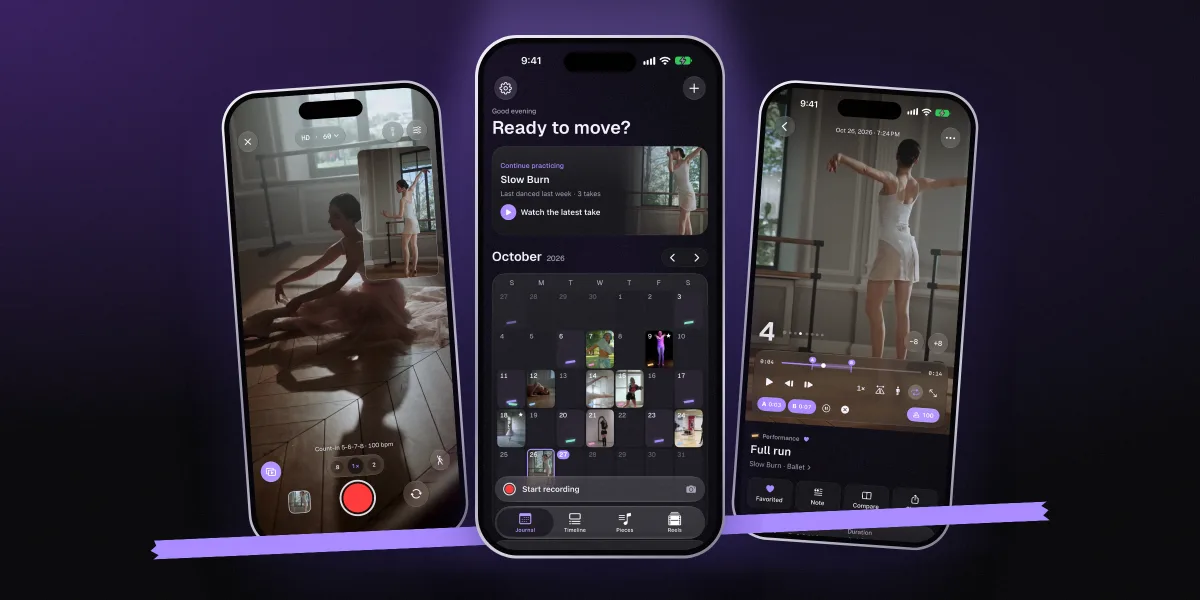
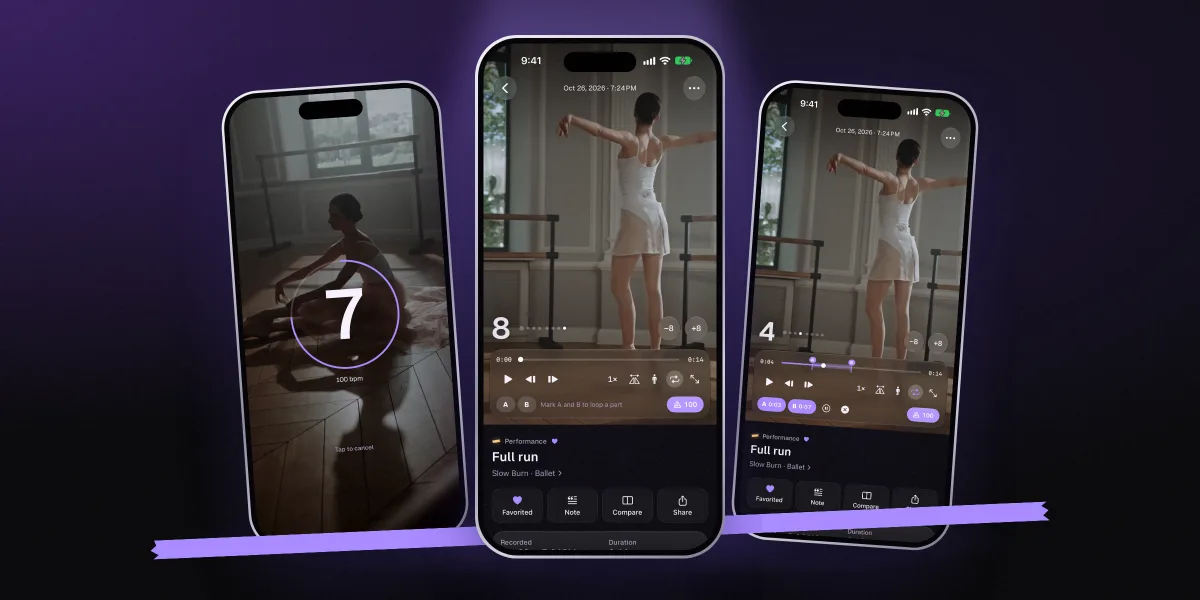
- A "5, 6, 7, 8" count-in before recording, at your tempo, with a click or haptics
- Slow motion down to 0.25× to hear every "and"
Hear the eights in your own takes
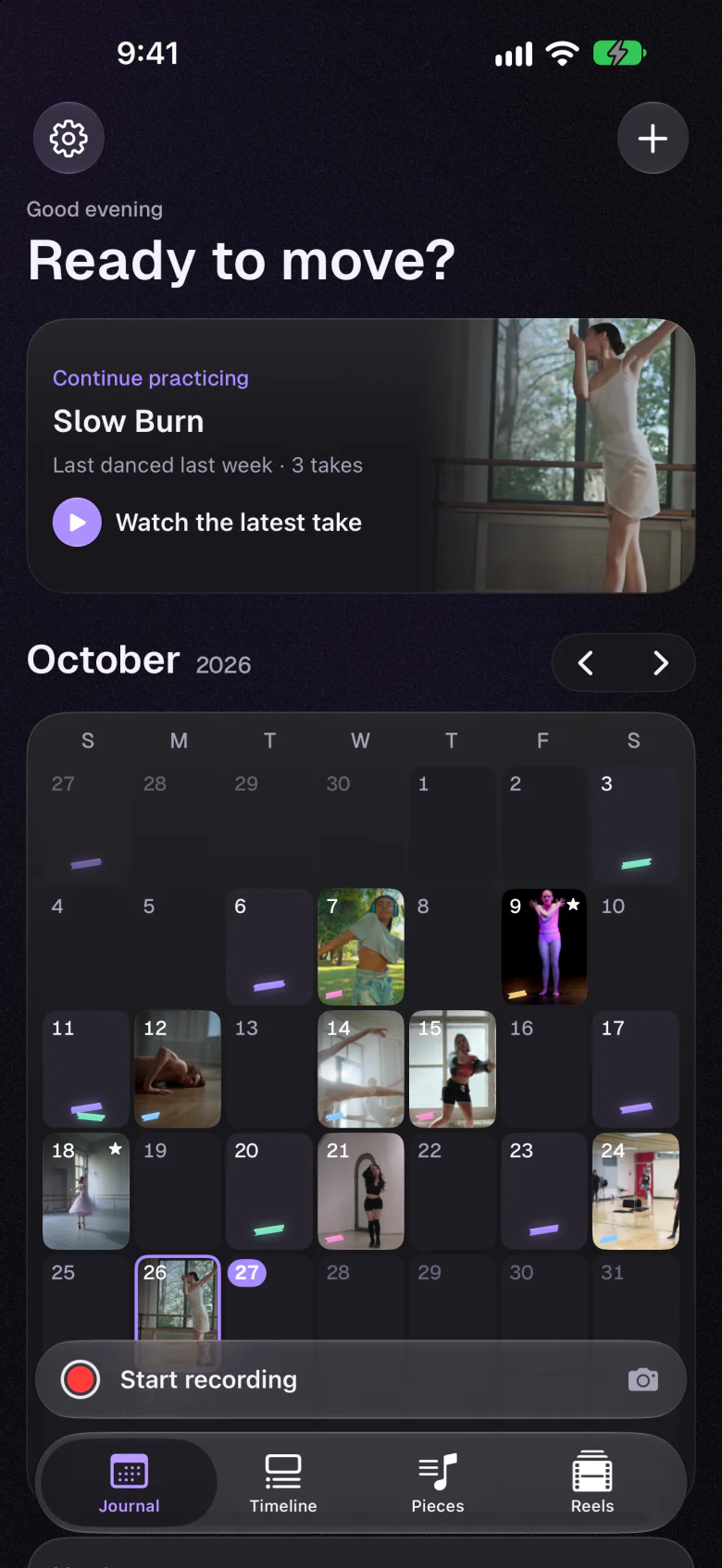
Dancify's count-in, counts overlay and A–B loop are free, on iPhone and iPad. No account, no ads.
- Count-in at your tempo
- Counts overlay with tap tempo
- Jump and loop by eight-counts
Questions, answered
What does "5, 6, 7, 8" mean in dance?
It's a count-in. The teacher counts the last four beats of an eight-count out loud, in the tempo of the music, so everyone starts together on the next 1. It tells you the tempo, when 1 will land, and gives you four counts to get ready.
What is an eight-count in dance?
Eight beats of music counted 1 to 8, which is two bars of 4/4 time. Choreography is usually built and taught in eight-counts, and four eight-counts usually make one musical phrase of 32 beats.
How do I find the one in a song?
Find the steady pulse, then the backbeat: in most pop and hip-hop the snare or clap is on 2 and 4, so 1 is the beat before the first snare. Then listen for where something changes, such as the vocals coming in or the chorus starting. That's usually 1 of a phrase.
What does "and" mean in dance counts?
The "and" is the half-beat between two counts: "1 and 2 and". A move counted "and-1" starts just before the beat. Steps that land on an "and" instead of a number are syncopated.
How do you count a waltz?
A waltz is in 3/4, three beats per bar, counted "1, 2, 3" with the 1 strongest. Teachers often count two bars as six, or use "and-a-1" for a pick-up into the bar. Competition waltz is played at 28 to 30 bars per minute, about 84 to 90 beats per minute.
What BPM is good for dance practice?
It depends on the style: about 84 to 90 BPM for a slow waltz, 120 to 128 for cha-cha, roughly 160 to 220 for salsa. When learning, practise a combination a little slower than the real tempo, then raise it step by step until you can dance it at the track's speed.
Sources
- Measures and time signatures. Music Appreciation 1, Lumen Learning. Checked 2026-11-04. courses.lumenlearning.com
- WDSF Professional Division Competition Rules, rule 9: Maximum duration of dances; tempi. World DanceSport Federation. Checked 2026-11-04. cdnb.worlddancesport.org
- Salsa vs bachata: what's the difference? SalsaVida. Checked 2026-11-04. salsavida.com
- Tempo and genre. Ableton Learning Music. Checked 2026-11-04. learningmusic.ableton.com