Dancify
Learning7 min read
How to learn choreography faster and actually remember it
Quick learners aren't magic. They map the piece, learn it in eight-counts, mark before they dance full out and check themselves on video. The method, step by step, with a 45-minute session plan.
On this page
Some dancers seem to pick up a combination after two run-throughs. It isn't magic and it usually isn't talent. They watch in a particular way, break the piece into pieces, mark before they dance it full out, and check themselves on video. All of that can be learned. Here's the method, from the first viewing to the night before the show.
To learn choreography faster, watch the whole piece once, then learn it in chunks of one or two eight-counts: feet first, then arms, then details. Mark each chunk small before dancing it full out, say the counts out loud, chain each new chunk onto the ones before, and film yourself to check against the reference. Slow the video down for the hard parts, and review the next day.
- Chunk: one or two eight-counts at a time, added on to what you already know.
- Mark: walking it through small isn't lazy. In one study, marked practice led to better performance.1
- Check: film each chunk; your memory of a move and the move itself are often different.
Watch the whole piece first
Before you learn a single step, watch the full routine, or as much as you've been given, two or three times without moving. You're making a map:
- Sections: intro, verse, chorus, bridge, ending. Give each one a name you'll remember ("the floor bit", "the canon").
- Repeats: a chorus that comes back three times is one thing to learn, not three. Choreographers repeat more than it seems.
- Count it: how many eight-counts per section? Knowing "the verse is four eights" tells you when you're lost.
- Travel and facings: where on the floor does each section happen, and which way are you facing?
Experienced dancers lean on structure without thinking about it. In a classic study, young expert ballet dancers recalled choreographed sequences much better than random ones, and music at recall helped them hold on to the end of the sequence.2 The map gives your memory something to hang on to.
Learn in chunks of eight
- Pick one or two eight-counts. Never more. If a single eight is dense, take it four counts at a time.
- Feet first. Weight changes, direction and timing. Get the floor pattern right before anything else.
- Then arms. Add the upper body once the feet are automatic. Trying both at once is where most combinations fall apart.
- Then the details. Head, focus, hands, dynamics, the face. This is what makes it the choreography and not just the steps.
- Say the counts. Out loud, with the accents: "five, six, seven-and-eight". Or the sound words your teacher uses ("boom, ta, pssh"). Speaking it builds a second memory alongside the body.
- Chain it on. Learn chunk two, then dance one into two. Learn three, then one into two into three. The joins are where people forget, so practise the joins.
Start somewhere other than the top. If you always run from the beginning, the first eight gets twenty repetitions and the last one gets two. Start some runs from the middle or the last section, so the ending is as solid as the opening.
Mark it before you dance it
Marking means walking through the choreography with reduced movement: hands sketching the arms, small steps for jumps, the head showing the turns. Dancers have always done it to save energy, but it seems to help the memory too. When dance students practised one routine full out and another by marking, they performed the marked routine better.1 The researchers' explanation: with less physical effort to manage, there's more attention left for the order, the timing and the shapes.
A good pattern: mark a new chunk two or three times, dance it full out once, mark it again while you fix what went wrong, then dance it full out with the music.
Counts or music?
Both, in that order. Counts give you structure: you know exactly where each move lands. Music gives you the feel: the accents, the breaths, the lyrics that cue a move. Learn a chunk on counts, then dance it to the track at once, so the counts get attached to the sound. If counting itself is the hard part, our guide to counting music in dance explains eight-counts, "and" counts and finding the one.
One trick from teachers: pick out landmarks in the music. "The arm goes up on the word 'fire'" sticks better than "on 6 of the third eight".
Mirror or no mirror?
The mirror is a wonderful tool for learning shapes. It can also become a crutch. A 2024 study of ballet dancers summarises earlier work by Radell and colleagues suggesting that performance and skill learning may suffer when the mirror is the main source of feedback, and the authors recommend training both with and without it.3
- Learning from a video: if the teacher faces you, mirror the video so their right is your right. If they face away, you can follow directly.
- Once you know a chunk: turn away from the mirror, or face a wall, and dance it from memory. That's what the stage will feel like.
- Then film it: the camera is a mirror you can look at after you've finished dancing.
Slow it down, loop it, film it
Speed is the last thing to add. Most fast choreography is unlearnable at tempo and easy at half speed.
| Stage | Video speed | What you're doing |
|---|---|---|
| Decode | 0.25× to 0.5× | Working out what the feet and arms actually do, frame by frame if needed |
| Learn | 0.5× to 0.75× | Dancing along, marking, saying the counts |
| Clean | 0.75× to 1× | Full out, fixing details, adding dynamics |
| Perform | 1× | From the top, with the music, no stopping |
Loop the one eight-count that keeps going wrong instead of running the whole piece again. Ten loops of the hard part beat three full runs.
Then film each chunk as soon as you think you have it. The video answers questions memory can't: is the arm really at shoulder height? Is the turn on 7 or on 7-and? Put your take next to the reference and look for one difference at a time. Our guide to filming yourself dancing covers the camera setup.
Between practices: listen, visualise, sleep
Listen to the track on repeat. On the bus, washing up, anywhere. You want to know what comes next in the music before your body has to.
Run it in your head. Mental practice has a measurable, positive effect on performance in a large meta-analysis, though how much depends on the task.4 Imagine dancing it at full speed from your own eyes, counts and all. It doesn't replace dancing, but it's practice you can do anywhere.
Sleep on it, then review. Motor learning keeps settling overnight; in one study, a practised movement sequence was about 20% faster after sleep.5 Start the next practice by dancing yesterday's chunks before learning new ones.
A 45-minute learning session
- 5 min: reviewMark and then dance everything you learned last time, with the music.
- 25 min: new chunksTwo to four new eight-counts: decode slowly, mark, count, dance, chain.
- 10 min: film and checkOne take of everything so far. Watch it once, note one fix.
- 5 min: write it downWhere you stopped, what's shaky, tomorrow's first task. That's your practice journal.
How Dancify helps you learn a piece
We designed Dancify's practice tools around this exact routine, and they're free.
Chunk it, loop it, film it
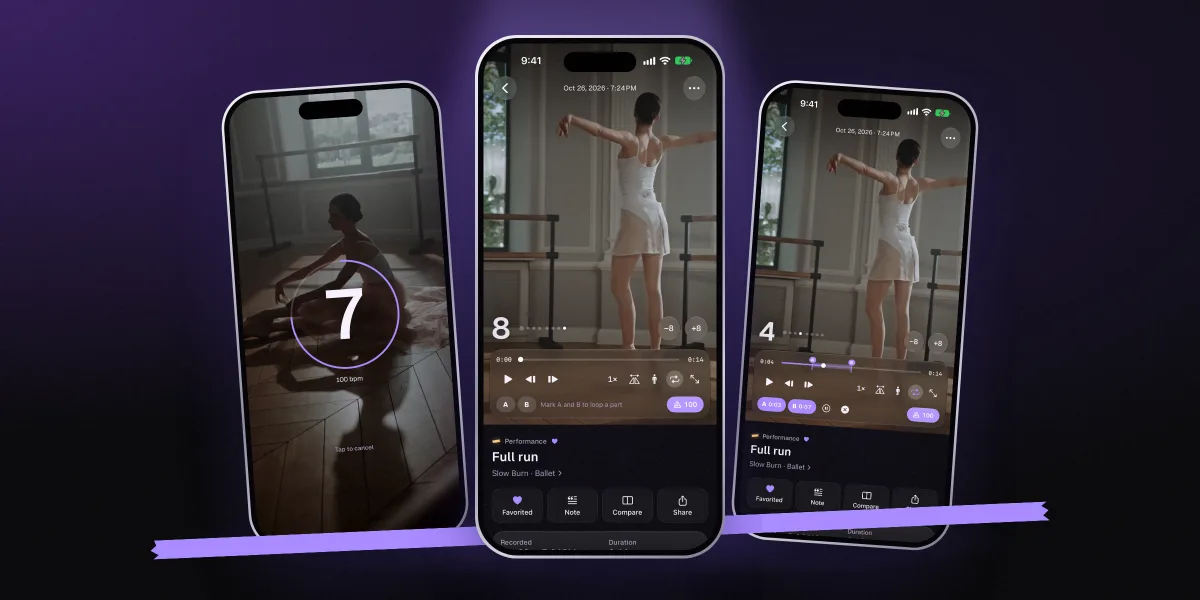
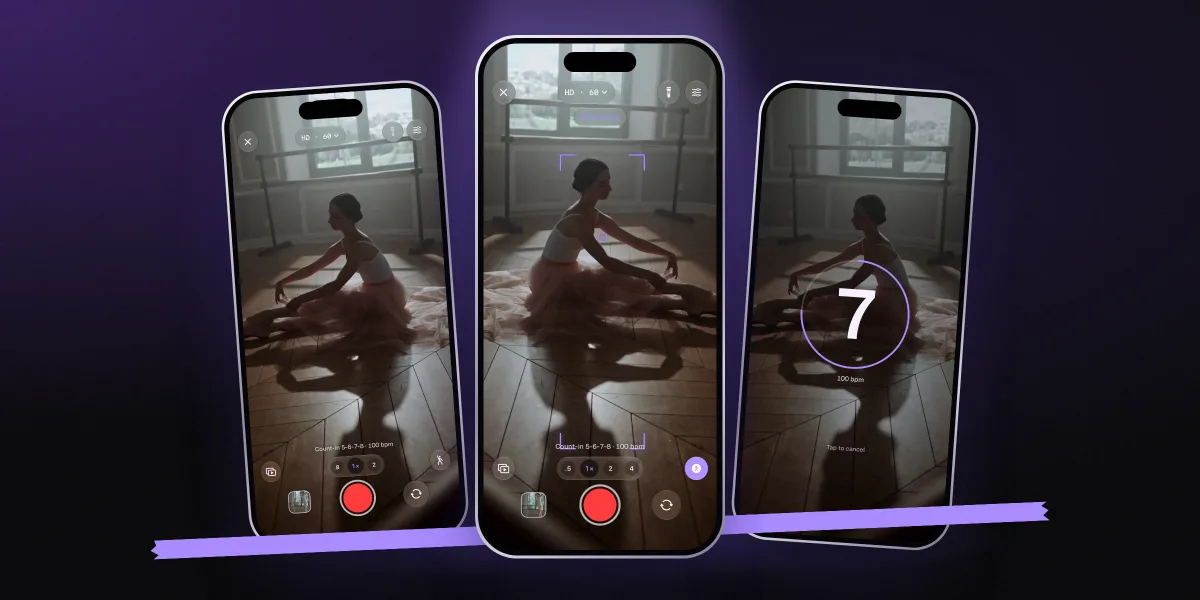
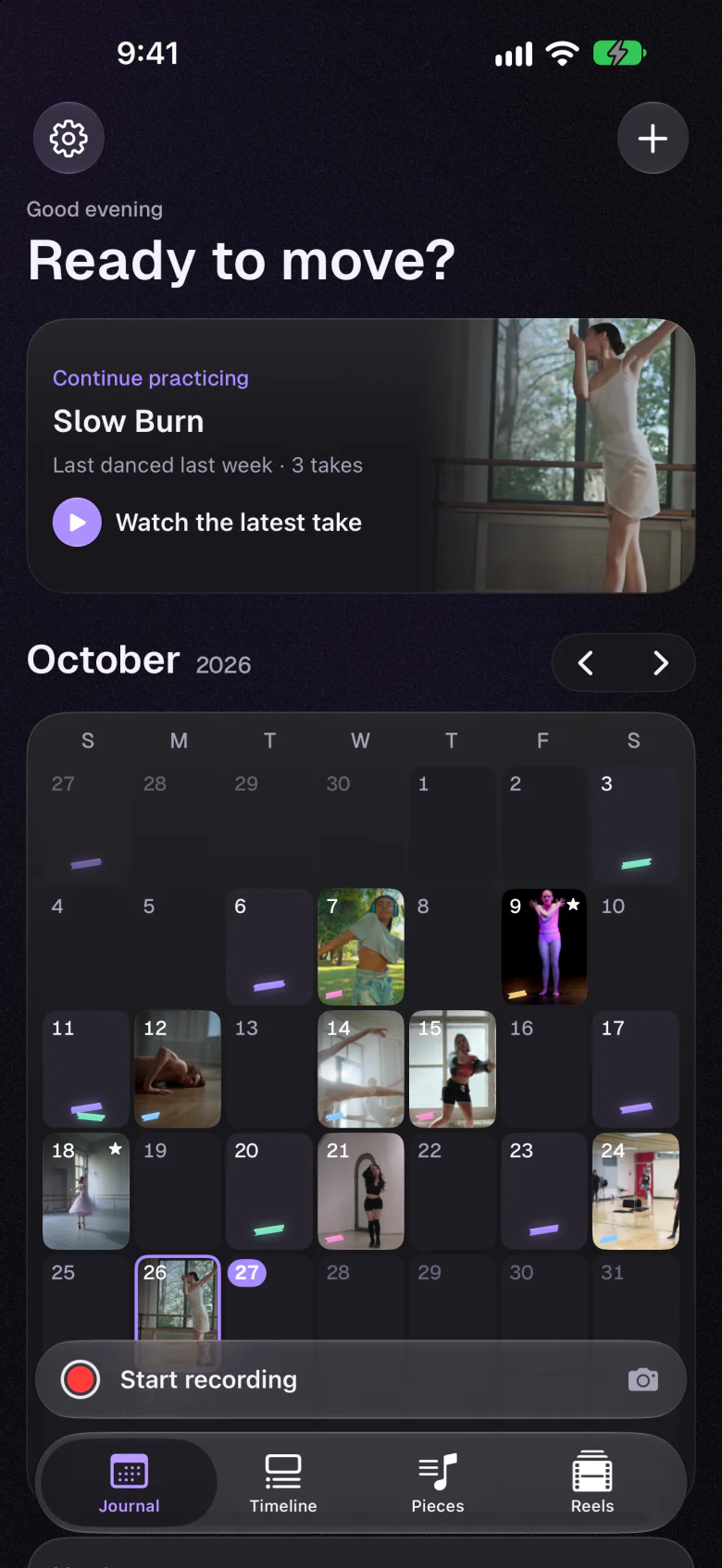
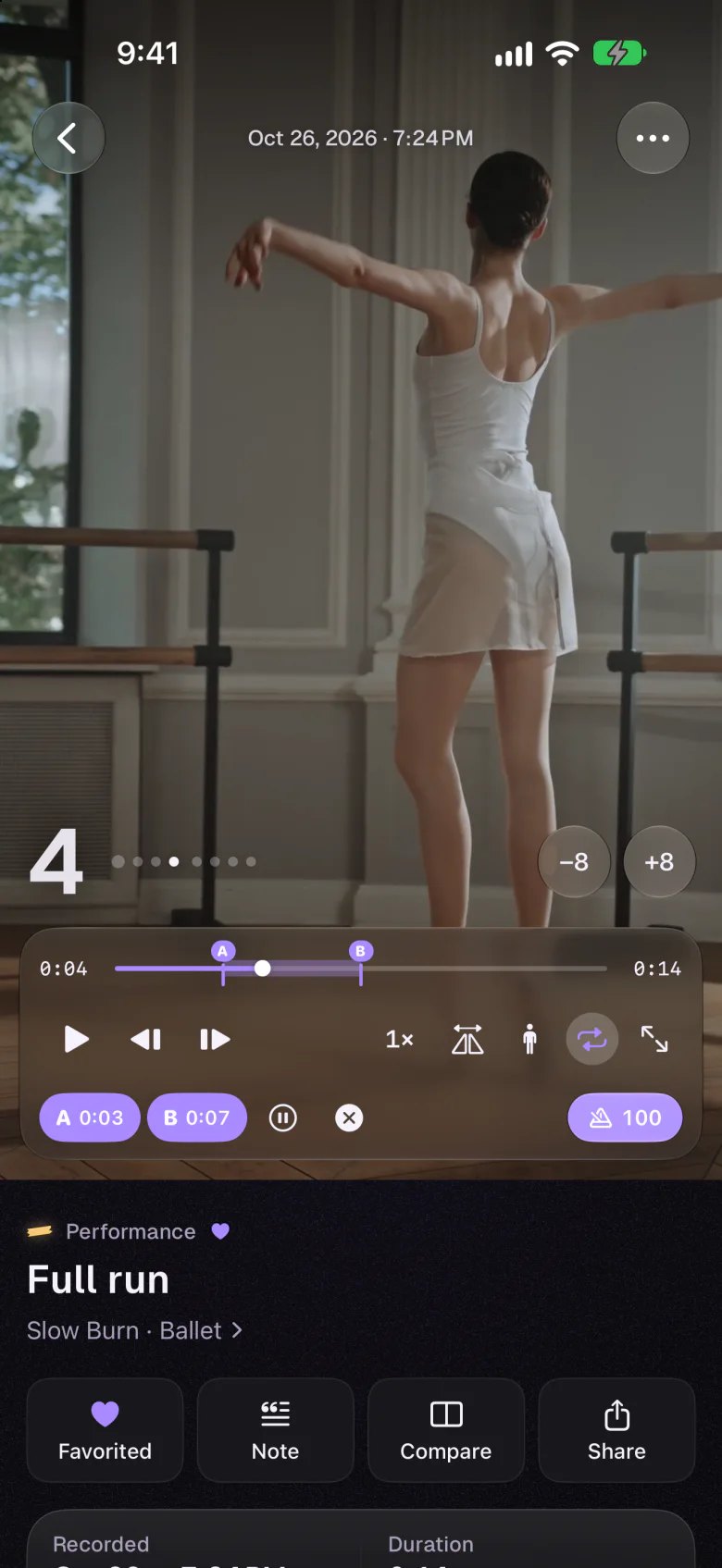
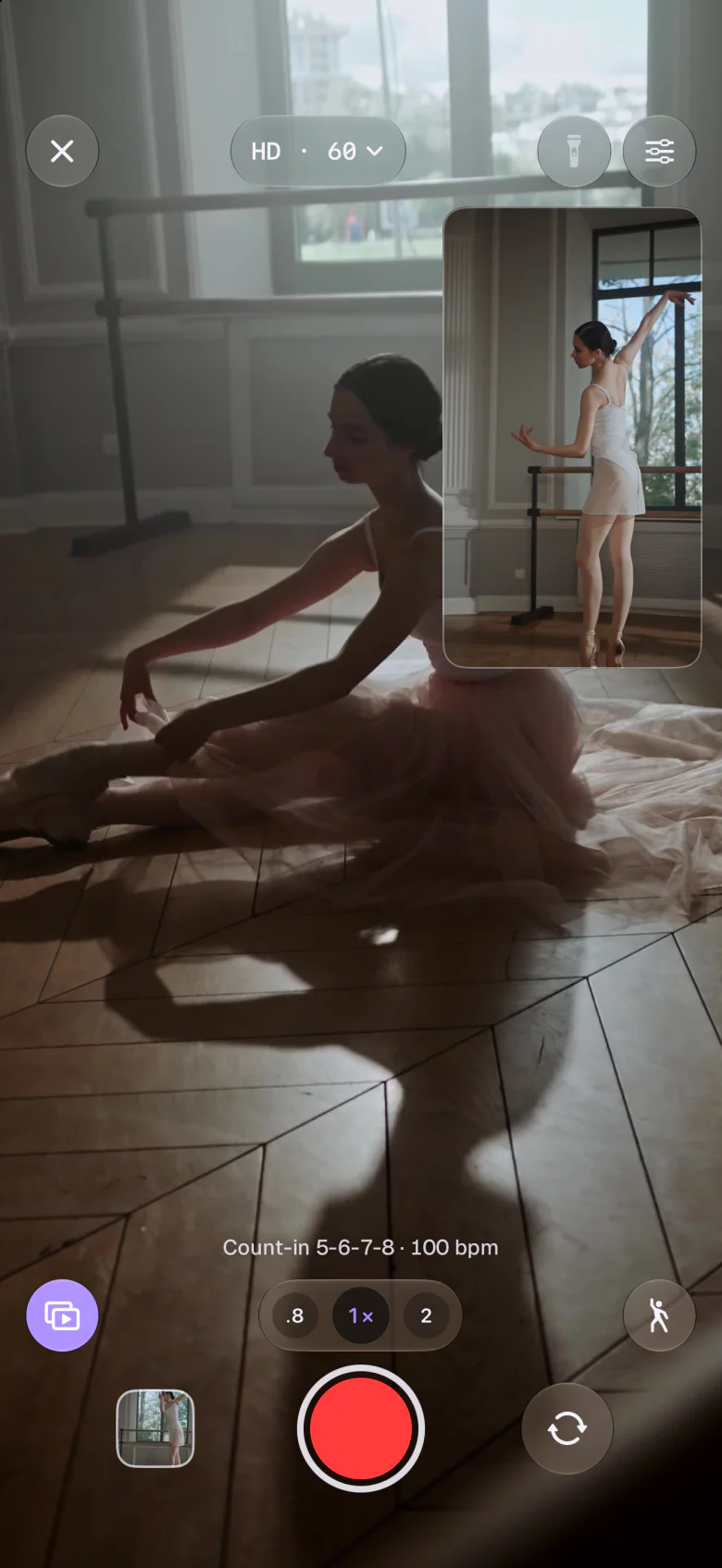
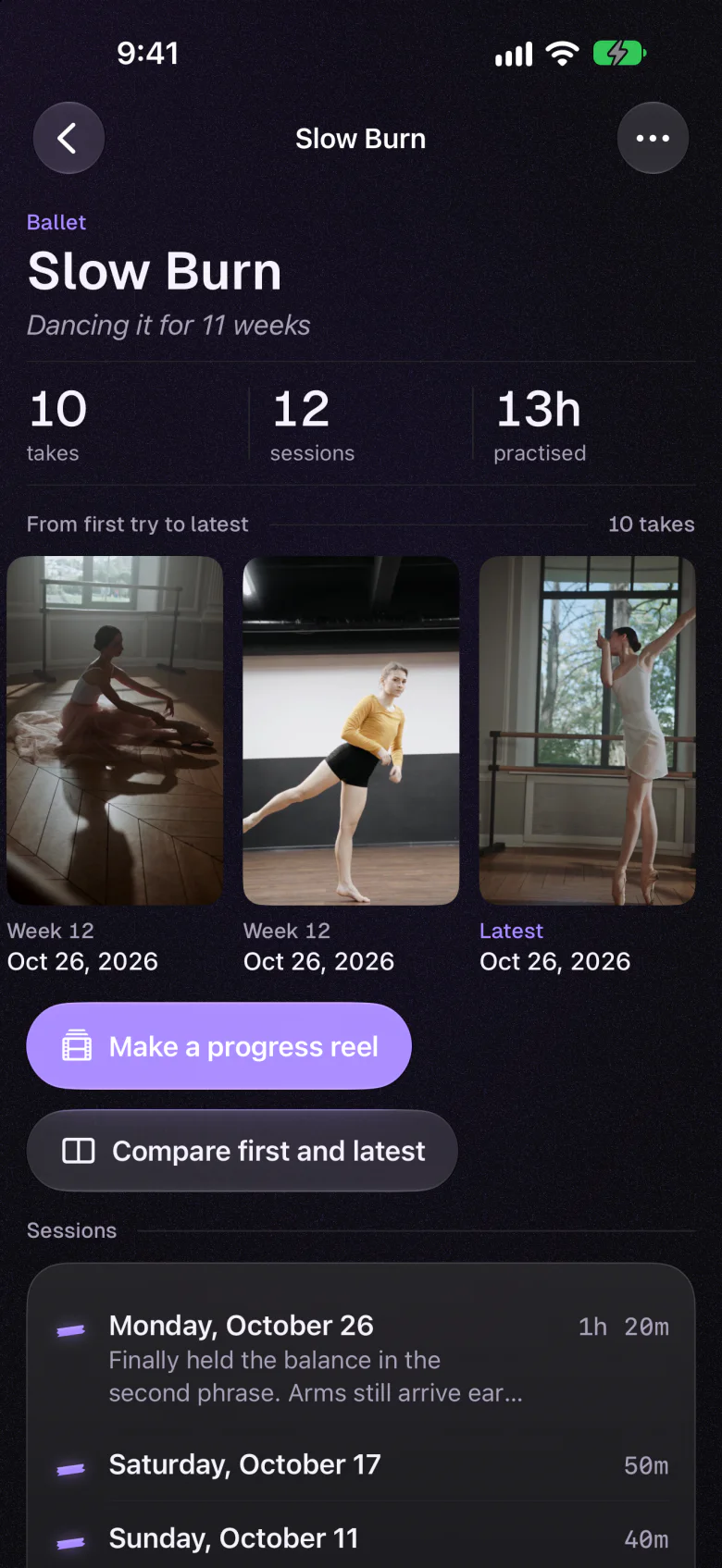
Dancify keeps the reference, the loop and every take of a piece in one place, on iPhone and iPad.
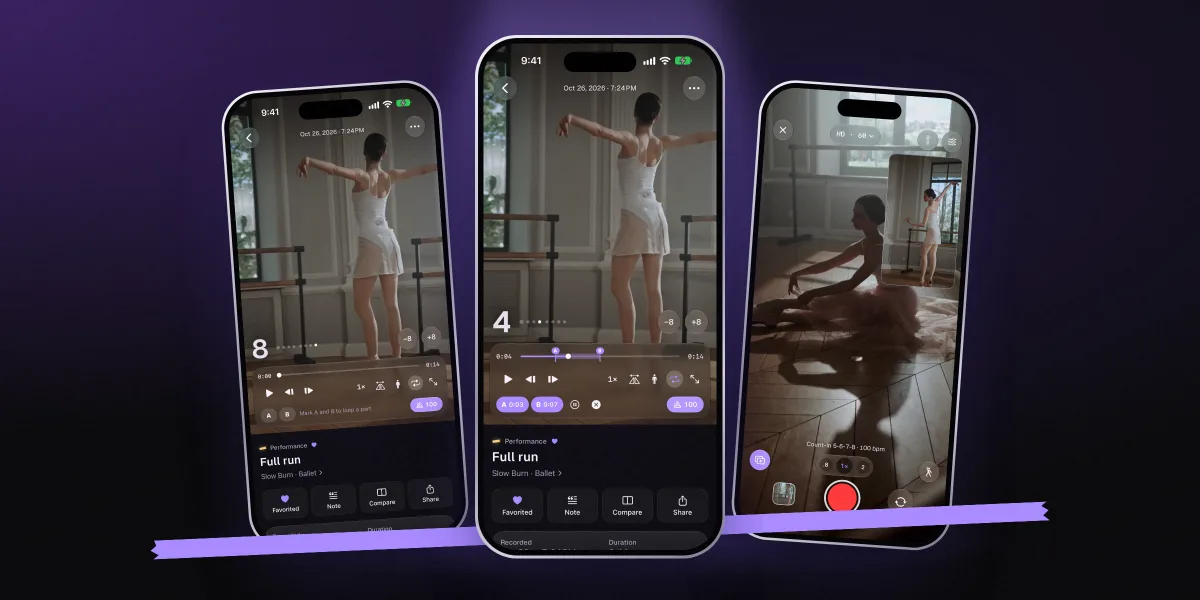
- Slow motion down to 0.25×, frame by frame, mirror
- A–B loop and counts overlay
- Reference video while you film
Questions, answered
How can I learn choreography faster?
Watch the whole piece first to map its sections and repeats, then learn it one or two eight-counts at a time: feet first, then arms, then details. Mark each chunk before dancing it full out, say the counts aloud, chain new chunks onto old ones, slow the video down for hard parts and film yourself to check.
How do dancers remember long routines?
They lean on structure: named sections, repeated choruses, counts and musical landmarks such as a lyric that cues a move. Research on young ballet dancers found choreographed sequences are remembered far better than random ones, and that music helps recall. Regular review, a good night's sleep and starting runs from different sections all help too.
Is marking choreography a good way to practise?
Yes. Marking, dancing the choreography small with reduced movement, saves energy and seems to free attention for the order, timing and shapes. In a study of dance students, the routine practised by marking was performed better than the one practised full out. Mix marking with full-out runs.
Should I mirror a dance video when learning it?
Mirror it when the teacher in the video faces you, so their right is your right. If they face away from the camera, follow it as it is. Once you know a section, dance it facing away from any mirror and film it to check.
What speed should I practise choreography at?
Decode new moves at 0.25× to 0.5×, learn them at 0.5× to 0.75×, clean them at 0.75× to full speed, then perform from the top at 1×. Loop the one eight-count that keeps going wrong rather than running the whole piece again.
Sources
- Warburton EC, Wilson M, Lynch M, Cuykendall S (2013). The cognitive benefits of movement reduction: evidence from dance marking. Psychological Science 24(9), 1732–1739. Checked 2026-11-04. doi.org
- Starkes JL, Deakin JM, Lindley S, Crisp F (1987). Motor versus verbal recall of ballet sequences by young expert dancers. Journal of Sport Psychology 9(3), 222–230. Checked 2026-11-04. doi.org
- Duboff LA, DiPasquale S, Ives SJ (2024). Investigating the effects of visual feedback on muscle activity, heart rate, RPE, and perceptions of performance in ballet dancers. International Journal of Exercise Science 17(1), 1056–1067. Checked 2026-11-04. pmc.ncbi.nlm.nih.gov
- Driskell JE, Copper C, Moran A (1994). Does mental practice enhance performance? Journal of Applied Psychology 79(4), 481–492. Checked 2026-11-04. doi.org
- Walker MP, Brakefield T, Morgan A, Hobson JA, Stickgold R (2002). Practice with sleep makes perfect: sleep-dependent motor skill learning. Neuron 35(1), 205–211. Checked 2026-11-04. pubmed.ncbi.nlm.nih.gov